Ten GEQs vs. One 10GEQ
Now that we know how to stochastically simulate thousands of battles to calculate win probabilities, we can start to look into some of the more interesting tactical considerations in building army lists and playing games.
What is a 10GEQ?
40k isn’t like real life in many ways - but in particular models don’t lose combat effectiveness when damaged. A Leman Russ on one wound fires the same number and strength weapons as a Leman Russ on full health.
Our Red side will be the 40 point squad of 10 GEQs from last time, and they’re pitted against a Blue Monster, with the stat line below:
| WS | BS | S | T | W | A | Ld | Sv | |
|---|---|---|---|---|---|---|---|---|
| Blue Monster | 4+ | 4+ | 3 | 3 | 10 | 10 | 6 | 5+ |
The Blue Monster will be armed with a Blue Lasgun, with the stats below:
| Range | Type | S | AP | D | |
|---|---|---|---|---|---|
| Blue Lasgun | 24” | Rapid Fire 10 | 3 | 0 | 1 |
While the naming is poor (!) you can see it’s just got 10x the wounds, attacks and Rapid Fire of a GEQ, and so is just 10 GEQs combined into a single model.
How Big does the Red Side have to be to Defeat It?
We can run the Python logic from last time to simulate a million battles with different numbers of Red GEQs fighting the Blue Monster.
The table below shows the outputs; each cell is the probability that Red Wins implied from the battle results. For example, row 16 says there’s an 86.5% chance that 16 GEQs will beat the Blue Monster if they go first, but only a 69.0% chance if they go second (the significant difference between these two numbers isn’t a suprise given the conclusions of the previous article).
| # GEQs on Red | P(Red Wins|Red Goes First) | P(Red Wins|Blue Goes First) |
|---|---|---|
| 5 | 0.01% | 0.00% |
| 6 | 0.14% | 0.03% |
| 7 | 0.65% | 0.16% |
| 8 | 2.28% | 0.63% |
| 9 | 6.13% | 1.95% |
| 10 | 13.18% | 4.92% |
| 11 | 23.98% | 10.35% |
| 12 | 37.71% | 18.83% |
| 13 | 52.42% | 29.96% |
| 14 | 66.15% | 42.98% |
| 15 | 77.84% | 56.53% |
| 16 | 86.52% | 69.00% |
| 17 | 92.39% | 79.26% |
| 18 | 96.06% | 87.05% |
| 19 | 98.09% | 92.44% |
| 20 | 99.13% | 95.83% |
| 21 | 99.64% | 97.85% |
| 22 | 99.85% | 98.97% |
| 23 | 99.95% | 99.52% |
| 24 | 99.98% | 99.80% |
| 25 | 99.99% | 99.92% |
| 26 | 100.00% | 99.97% |
Looking at the row for “10” it’s clear combining the 10 GEQs into a single Blue Monster is hugely advantagous. The first player in a normal 10 GEQ vs. 10 GEQ battle has a 63.72% probability of winning, but if the second player has a Blue Monster instead of 10 separate GEQs (and so their firepower doesn’t deteriorate as the Blue Monster gets damaged) then the first player’s probability of winning drops to 13.18%!
How Many Points Should the Blue Monster Be?
Each GEQ is 4 points each, so how many points should a Blue Monster be? A fair number way to calculate the point value is to see how many GEQs you’d have to face to get a 50% probability of winning, and multiply that by 4 points per GEQ.
Let’s say the GEQs go first; 12 GEQs would have a 37.71% chance of winning and 13 GEQs would have a 52.42% chance of winning, so the Blue monster is equivalent to somewhere between 12 and 13 GEQs (48-52 points). Linearly interpolating between 12 and 13 GEQs based on the winning probabilities puts the Blue Monster at 12.84 GEQs, or 51 points.
If the GEQs go second the Blue Monster has a 50% chance of winning against 14.52 GEQs, so should be worth 58 points. However, we can only pick a single points value for our Datasheet, so lets take the mean of 51 and 58 points and say a Blue Monster costs 55 points.
Why Stop at 10?
The Blue Monster is 55 points vs. the 10 GEQ squad’s 40 points - a 37.5% increase in value just because it doesn’t lose firepower as it takes damage.
How should you use this information when picking an army list? This analysis can help you think about when to pick fewer stronger units vs. when to pick more numerous but weaker units. For example, if your codex had Blue Monsters at just 44 points you would always take them in preference to GEQs (all else being equal) as the results above show they are more combat effective, at least in our simple shooting-only battles, than the 11 GEQs you’d be getting instead.
The chart below shows the results of repeating this methodology for varying combinations of GEQs. You can see at $x = 10$ our Blue Monster (10 GEQs combined) gives a 37.5% increase over 10 GEQs fighting individually, and so has a $y$ of 137.5%. Similarly, if you don’t combine your GEQs together ($x = 1$) then you have no advantage ($y = 100%$, there’s a 2% error in the methodology here).
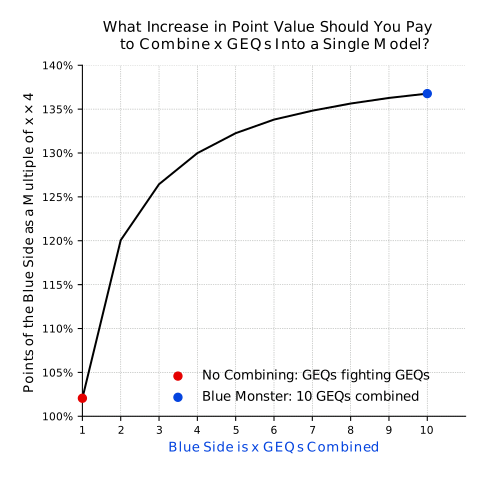
It’s interesting that the curve looks logarithmic; the benefit from combining more and more models together into larger units tails off. It’s also interesting that the benefit of combining 2 GEQs into a single 2 wound model with a Rapid Fire 2 lasgun (20.0% over $2 \times 4$ points) is a bigger increase than the incremental increase as going from combining 2 to 10 GEQs in a single model (16.7%).
In conclusion, when picking army lists if you can find models in your codex below this curve they’re probably cheaper in points terms than they should be, and similarly if you see models above the curve you’re probabily overpaying in points for their relative increase in strength.